


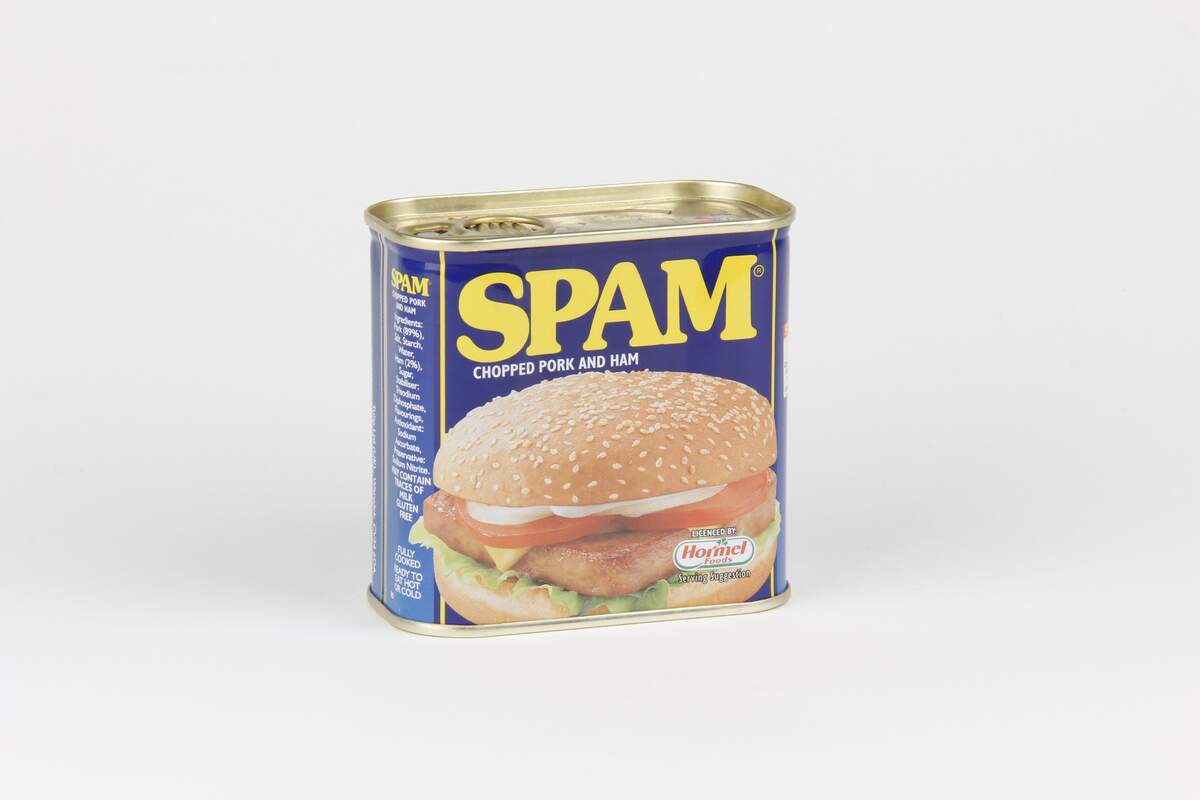
National SPAM Day
Observed
annually on July 31st
Dates
Tags
Food & Drink
Hashtags
Sources
https://blog.thenibble.com/2022/07/31/spam-recipes-for-national-spam-day-plus-what-is-spam/
https://en.wikipedia.org/wiki/Spam_(food)
https://myemail.constantcontact.com/Garland-City-Press-Briefs---July-24--2022.html?soid=1103244715117&aid=k9C99IcThr8
https://www.instagram.com/p/CvYHmwjRRzC/
https://www.spam.com/what-is-spam-brand
National SPAM Day celebrates SPAM! A lunch meat made and distributed by Hormel Foods, Classic SPAM is packaged as a 12-ounce loaf of ground and seasoned meat in a can. The original recipe, on shelves since 1937, consisted of ground pork shoulder and ham mixed with water, sugar, salt, and sodium nitrite, a preservative that also gives it its pink color. The only change in the recipe since then has been the addition in 2009 of modified potato starch, a binder that helps mitigate the layer of gelatin that forms on the top of the loaf. SPAM is precooked, so it can be eaten straight from the can, but it is often cooked again, being used to make many dishes. It's used as a breakfast meat and sandwich meat, and is used in stir-fries, tacos, and spaghetti.
In 1929, Jay Hormel succeeded his father, George A. Hormel, the founder of the Hormel slaughterhouse and meatpacking facility in Austin, Minnesota, which processed whole hogs, beef, and sausage casings. Jay Hormel began selling a six-pound loaf of pork luncheon meat to deli and sandwich counters. On account of its popularity, Hormel designed a shelf-stable version of it for home use. Pork shoulder was not a highly sought-after part of the pig, and there was also hope that the new product would increase the sales of pork shoulder. A naming contest was held, and the brother of one of the company's vice presidents won the $100 prize after coming up with "SPAM." It's thought that the name is a portmanteau of "spice" and "ham."
During the Great Depression, SPAM filled the gap for inexpensive meat products, being an affordable substitute for more expensive meats, and was often used in place of bacon or ham. By 1940, 70 percent of city dwellers in the United States were eating SPAM. But World War II was the driving force to its growth around the world, its greater permeation of culture, and its longevity. More than 100 million cans of SPAM were shipped to troops overseas during the War, in large part because it was difficult to bring fresh meat to troops on the front lines. Soldiers gave it names like "SPecial Army Meat," "meatloaf without basic training," and "ham that didn't pass its physical."
Many servicemen had eaten SPAM three times a day during the War, and thus didn't want to eat it when they returned home. But it became popular with the public, and largely shifted from being a main protein source to being a side, such as being served with eggs or being used to make sandwiches. With its high fat and sodium content, as well as preservatives, SPAM is not known for being a health food, but that hasn't slowed it down.
During the War and the occupations that followed it, SPAM was introduced and took hold in Guam, Hawaii, the Philippines, Okinawa, and on other Pacific islands. Fishing sanctions and food rationing in Hawaii made it fertile ground for SPAM to become an important meat substitute, which it has remained since. It is found anywhere from fine dining restaurants to delis in grocery stores, and Hawaii now has the highest per capita consumption of SPAM in the United States. Japanese immigrants to the islands created SPAM musubi, a variation of a Japanese rice ball, which has its own holiday on August 8. SPAM fried wontons are also common, and SPAM is even available at Burger King and McDonald's. Hawaii is also home to the Waikiki SPAM Jam festival.
War rationing also led to the proliferation of SPAM in the Philippines. SPAM was added to garlic fried rice and eaten for breakfast, becoming known as SPAMsilog. SPAM is extremely popular in Guam, where average per capita consumption is about 16 cans a year. SPAM also took hold in Korea, with budae jjigae, "army base stew," becoming common. SPAM is used in many dishes in Hong Kong, one being SPAM and eggs in a soft bun. In Asia, SPAM is given as a gift during the Lunar New Year and as a wedding gift. In the United Kingdom, where SPAM also took hold because of rationing during World War II, SPAM fritters are prepared in a way similar to the fish in fish and chips.
The billionth can of SPAM was sold in 1959, and 8 billion cans had been sold by 2012. Austin, Minnesota, is now known as SPAM Town USA. Now there are more than a dozen varieties of SPAM, with different kinds of meat and flavors, and there are also "lite" and low-sodium versions. No wonder there is also a National SPAM Day, and lucky for us, it is celebrated today!
How to Observe National SPAM Day
- Try one one the many varieties of SPAM.
- Enjoy some dishes made with SPAM. Recipes can be found on the SPAM website and in books such as The Ultimate SPAM Cookbook.
- Try your hand at a SPAM dish common around the world such as SPAM musubi, SPAM fried wontons, SPAMsilog, budae jjigae, Hong Kong style SPAM and egg buns, or SPAM fritters.
- Visit the SPAM Museum in Austin, Minnesota, known as SPAM Town USA, where SPAM got its start and is headquartered.
- Follow SPAM on Facebook and Instagram.
- Pick up some SPAM merchandise.
- Check for National SPAM Day events being held in your city. For example, in Garland, Texas, in 2022, the city encouraged people to visit their Manufacturing Victory World War II exhibit at City Hall, and Main Street Cafe provided free SPAM sandwiches.
- Attend the next Waikiki SPAM Jam in Hawaii.
- Listen to "Spam" by "Weird Al" Yankovic.
- Read a book like SPAM: A Biography or SPAM: A Global History.
- Watch the Monty Python sketch about SPAM, where SPAM can't be avoided. Recorded in 1970, it inspired the concept of "spamming," or the receiving of unsolicited messages. The term was first used to apply to spam email in about 1993.
Exclusive Content
Enjoying Checkiday? It takes a lot of support from fans like you to run a free website. For exclusive content and other perks, please consider supporting us on Patreon. Thank you!Sponsor
This event does not currently have a sponsor. If you'd like to increase visibility for this event while gaining exposure for yourself or your brand, you can learn more here.Something Wrong or Missing?
We would love to hear from you! Please contact us using this form.Observation Notifications
Would you like to be notified before the next observation? Add this event directly to your calendar with this link. You may also sign up here to be told when other notifications are available!Also on this date…


Don't miss a beat! Subscribe to any of the following feeds for daily updates.
turned_in














 notifications